
Year End Review and Outlook 2026

Looking back on 2025, we would summarize the market environment this year as one that was simultaneously familiar while at the same time quietly transitional. U.S. equities once again delivered returns that were strong in absolute terms relative to long-term historical averages, supported in large part by the continued strength of a narrow group of very large, technology-oriented companies- the so-called “Mag(nificent) Seven.” Yet, despite that strong headline performance, 2025 was also a year in which the S&P 500 underperformed a number of developed-market equity indices across parts of Europe and Asia, marking a departure from recent years where “U.S. exceptionalism” was the order of the day.
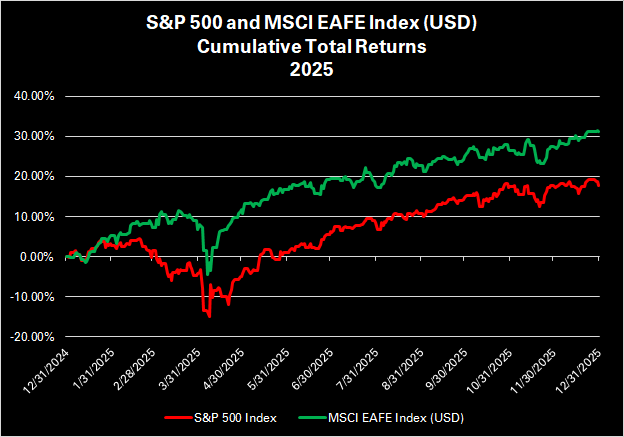
This combination of robust absolute performance in U.S. equities, paired with relative underperformance versus a meaningful portion of the developed world is, in our view, an important and telling feature of the current investment landscape. It reinforces several market themes we have discussed in recent years: the persistence of narrow leadership within U.S. markets, the widening dispersion in global equity valuations, and the growing relevance of a broader, internationally-oriented opportunity set at a time when a significant share of U.S. market returns continues to be derived from a small and highly visible group of businesses.
Throughout 2025, that extraordinary concentration of returns in U.S. mega-cap technology and technology-adjacent businesses remained the defining structural characteristic of domestic equity markets. Index-level outcomes were shaped disproportionately by a narrow cohort of companies, and market breadth indicators made this clear. While the capitalization-weighted S&P 500 produced strong absolute returns, equal-weighted measures saw more uneven performance, underscoring that underlying earnings strength and valuation support were not distributed uniformly across the market.
We view this dynamic as more than a statistical observation. When market leadership narrows and investor expectations cluster around a small number of themes, particularly themes tied to technological change and the productivity gains they are anticipated to yield, markets often become increasingly sensitive to even modest shifts in the narrative or economic outlook. In our eyes, 2025 was a year where we saw the clear implications of such a setup: while investors still enjoyed compelling returns from owning this narrow set of names (at least in the aggregate), several bouts of volatility experienced over the course of this year seemed to highlight how much optimism was baked into a select set of thematically connected businesses.
Of course, this was especially evident in the ongoing enthusiasm surrounding artificial intelligence. We fully acknowledge the potential for AI-related technologies to reshape elements of productivity, cost structures, and business processes over time, and we do not dismiss the possibility that these innovations may ultimately generate meaningful economic benefits. However, as we have written before, the timeline, magnitude, and distribution of those benefits all remain uncertain. The current phase of AI investment has been extremely capital-intensive, drawing significant spending into data infrastructure, semiconductor capacity, and energy systems, even as business models continue to evolve, and long-term returns on this capital remain uncertain.
Against that backdrop, we remain mindful of the extent to which U.S. equity valuations, particularly among larger, growth-oriented companies most directly associated with the AI investment cycle, already embed optimistic assumptions regarding both the pace and durability of these expected gains. History has shown that markets can be disappointed not only when outcomes are poor, but also when outcomes are merely less extraordinary than pricing had implied. Our concern here is not rooted in any type of outright pessimism about innovation, but rather stems from current valuations, persistent uncertainties, and if history is any indication, what both may portend for long-term returns. As we highlighted in a client note late last year, the long-term earnings yield on the S&P 500 is at levels last seen briefly during the post-COVID market euphoria in 2021, and before that, the very end of the Dot-Com era of the late 1990s/early 2000s. Though such low earnings yields tell us little to nothing about the trajectory of markets in the near term, historically they tend to be predictive of less attractive returns over the course of the subsequent decade. If nothing else this is, in our eyes, grounds for caution.

Source: Bloomberg
From a macroeconomic perspective, we would note that 2025 was another year in which the U.S. economy displayed resilience at the aggregate level while exhibiting increasingly mixed signals beneath the surface. Headline GDP growth remained positive, and many large companies continued to report earnings that exceeded the more conservative expectations held at the beginning of the year. Yet a closer examination of underlying data revealed clear signs of divergence. Portions of the labor market softened, hiring among smaller employers slowed, and several measures of job openings and private payroll growth drifted lower, even as reported unemployment levels remained relatively low.
Household conditions reflected a similar bifurcation. Wealthier households, particularly those with meaningful exposure to real estate and financial assets, continued to benefit from balance-sheet appreciation, which in turn helped support consumption among these upper-income cohorts. Meanwhile, indicators of financial stress among middle- and lower-income households, including revolving credit usage and delinquency trends, pointed toward growing strain. It is increasingly evident that while parts of the consumer economy remain healthy, others are showing signs of fatigue. The term “K-shaped” economy has been bandied about a good deal this year, but it is quite representative of the path of the two predominant “genres” of U.S. consumer: a smaller, wealthier cohort that continues to enjoy rising asset values (and is spending accordingly) and a larger mass of consumers that seems to be struggling with a real (or perceived) decline in their purchasing power. Increasingly it seems, the U.S. economy is becoming quite reliant on the former for growth. A study last year by Moody’s Analytics suggested that the top 10% of earners may now be responsible for nearly half of all spending in the U.S., a record level. Though this figure subsequently sparked some debate, there is no question that consumer confidence, though flagging across the board, appears to be holding up far better amongst the highest earning cohort of Americans (who, not coincidentally, own the preponderance of financial and real estate assets):

This divergence introduces additional complexity into the policy environment as we look toward 2026. An economy that appears stable in aggregate but uneven beneath the surface raises the risk that policy may shift either too quickly or too cautiously in response to changing conditions. It also reinforces our view that the U.S. economy, while still fundamentally strong in many respects, is unlikely to remain insulated indefinitely from the cumulative effects of higher structural deficits, tighter financing conditions, and a more fragmented global trade and security landscape.
It is within this context that our concerns about the potential for a policy mistake by the Federal Reserve remain elevated. Should economic momentum slow more visibly, particularly in areas outside the consumer segments that have benefitted most from asset price appreciation, the Fed may face pressure to ease monetary policy in an effort to support growth. While such a response would be understandable through a cyclical lens, we believe it carries the risk of inadvertently fostering a stagflationary environment, one in which economic activity decelerates even as inflationary pressures persist or re-emerge.
We do not present this as a foregone conclusion. However, it is our view that inflation remains an underappreciated and underpriced risk across a range of potential economic scenarios. Whether the U.S. ultimately experiences slower growth, remains in a moderate expansion, or re-accelerates in response to renewed stimulus or momentum, we see the possibility for inflation continuing to be a persistent issue. Structural forces including sustained fiscal spending levels, ongoing capital investment in supply-chain resiliency and national security, geopolitical competition, and the resource intensity of energy and industrial realignment (to say nothing of the often resource-intensive investments surrounding the development of artificial intelligence capabilities) all point toward an environment in which upward price pressures may prove more persistent than the disinflationary experience of prior decades might suggest.
In such a world, long-dated interest rates could remain volatile or structurally biased higher, with important implications for U.S. Treasuries and for the pricing of other U.S.-dollar-denominated assets, equities included. When we evaluate those risks in light of current U.S. equity valuations, especially among large-cap growth companies, we see little in the way of margin of safety.
Readers of our prior letters will recall that, over the past several years, we have articulated concerns regarding overvaluation in certain areas of U.S. markets, the fragility associated with narrow leadership, and the likelihood that inflation may persist as a meaningful risk factor rather than fade quietly into the background. We have also described what we believe to be a broader paradigm shift in the global economy, one characterized by greater geopolitical complexity, the regionalization of supply chains, increased investment in industrial and defense capacity, and tighter constraints around energy and natural resources.
In anticipation of such an environment, we have positioned portfolios accordingly. We have maintained exposures to businesses whose economics are tied directly or indirectly to real assets and inflation-linked activity, including energy and commodity-related holdings. We have continued to identify and invest in high-quality companies outside the United States trading at valuations that are, in many cases, meaningfully lower than those of comparable domestic peers, particularly within the small- and mid-cap segments of developed international markets, where investor engagement has been comparatively limited in recent years. Alongside these allocations, we have retained a disciplined reserve of liquid, short-duration assets, which allows portfolios to benefit from higher short-term yields while preserving the flexibility to take advantage of opportunities should volatility rise or valuations reset.
This orientation served client portfolios well over the course of 2025. While U.S. mega-cap technology businesses continued to dominate headlines and index weightings, many non-U.S. equities and real-asset-linked exposures generated equally attractive, if not superior, returns and contributed meaningfully to portfolio results. In our view, the past year provided a constructive validation of our broader strategic direction, a “proof of concept” suggesting that opportunities outside the narrow segments dominating U.S. indices can play an increasingly important role in portfolio outcomes as market leadership evolves.
One notable example on this front has been the ongoing development and progress of our Focused European Value Strategy. The strategy benefited this year from attractive valuations, improving operating performance in select businesses, and a more constructive environment for capital returns across portions of the European corporate landscape. Just as importantly, its results in 2025 reflected the cumulative effect of sustained fundamental research, extensive management dialogue, and disciplined portfolio construction. With a return of 36.7% for the year, the strategy not only contributed positively to outcomes for those involved, but also reinforced our conviction that Europe remains one of the most compelling opportunity sets for long-term, valuation-driven investors today. We should note that this was an exceptional year for the strategy performance-wise, well exceeding our long-term expectations for the strategy’s return profile. With that said, we do believe we are in the early stages of a longer period in which smaller European equities like those owned in this strategy outperform more publicized sectors of the market, but how this potential outperformance is distributed across calendar years is nearly impossible to determine. For those interested in learning more about the strategy, how we incorporate “on the ground” diligence and the key themes when it comes to investing in the region, we would highly recommend listening to the webinar we recorded in October.
Looking forward, we remain cautiously optimistic about the opportunity set that may emerge over the coming years. The same structural forces we have written and spoken about, including industrial renewal, supply-chain resilience, energy transition and security, and the realities of a more multipolar global system appear likely to support continued opportunity in inflation-linked and commodity-oriented businesses, as well as in high-quality non-U.S. small- and mid-cap companies where valuations remain comparatively attractive.
We would note that the idea that international equities and real-asset exposures can play a central role in navigating such an environment is not purely theoretical, but well-grounded in history There have been extended periods in the modern era where returns from non-U.S. markets significantly outpaced those available in the United States. The 1970s and 1980s are a good example: In the wake of the breakdown of Bretton Woods, the oil shocks of 1973 and 1979, and the subsequent battle against inflation, investors endured a long stretch of higher inflation, elevated interest rates, and considerable macro volatility. During that period, several international markets produced exceptionally strong equity returns.
Broader international benchmarks illustrate this quite well. Long-horizon comparisons between the S&P 500 and international indices such as MSCI EAFE Index show that non-U.S. equities enjoyed a sustained run of outperformance in the late 1970s and throughout the 1980s, with the relative gap widening most notably toward the end of that decade as export-driven economies experienced rapid growth off lower starting valuations and U.S. dollar weakness:

A similar pattern re-emerged in the 2000s. Following a decade in which U.S. equities, especially U.S. large-cap growth stocks, dominated returns, the bursting of the technology bubble in 2000 and the subsequent corporate and macroeconomic shocks of the decade produced what is now often referred to as the “lost decade” for U.S. large-cap equities. From the end of 2001 to the end of 2010, even after the impact of the Global Financial Crisis, the MSCI EAFE Index again delivered a total return meaningfully higher than that of the S&P 500. In addition, international developed markets outperformed the U.S. in most individual calendar years across that span, reflecting not only valuation dynamics but also stronger earnings growth across export-oriented economies and sectors tied to the powerful global commodity and industrial investment cycle of the time.

The backdrop for that cycle shared echoes with the present: elevated U.S. starting valuations following a long growth-led expansion, increased capital investment outside the United States, especially in supply chains (then to globalize, now to localize them), and a significant allocation of capital toward real assets and resource-intensive industries. Investors who maintained a meaningful international allocation during that period benefited from a durable diversification effect at a time when U.S. indices delivered relatively modest long-term returns.
While no historical pattern repeats perfectly, these episodes provide useful context. Leadership between U.S. and international equities has tended to evolve in cycles, often coinciding with shifts in inflation regimes, interest-rate environments, currency dynamics, and the geography of real investment activity. When we consider today’s combination of elevated U.S. valuations, wide valuation discounts abroad, structurally higher investment in energy and industrial capacity, and a more complex geopolitical environment, we believe it is reasonable to view the current moment as one in which non-U.S. markets and real-asset-linked businesses may again be an important long-term driver of portfolio returns.
At the same time, we continue to view our cash and short-duration holdings not as a passive defensive stance, but as a source of strategic flexibility. Should markets deliver periods of volatility or dislocation, whether driven by shifts in policy, changes in leadership, or reassessments of valuation, we would welcome the opportunity to deploy capital into compelling long-term investments at more favorable entry points, particularly in the areas where our research remains most active.
We would like to note that, for clients who share our constructive view on non-U.S. equity opportunities, we would invite a further, more in-depth conversation around our Focused European Value Strategy. While we manage portfolios on a discretionary basis, participation in this strategy requires the establishment of a separate, dedicated taxable account- a straightforward process, but one that requires an explicit decision to “opt in”. We are genuinely excited about the long-term prospects of this strategy and would welcome the opportunity to discuss our research and portfolio construction approach here in greater depth. We also plan on having a webinar at some point in the first quarter of this year to update our investors in the strategy, and we will be sharing access to that with you once scheduled. While quite similar to what we are doing in “core” portfolios from a methodology standpoint, we view this strategy to be quite complementary to our efforts on the predominantly domestic/U.S.-listed side, while offering attractive diversification at a time when, long-term, this may be to investor’s benefit.
More broadly, if you would like to talk through our views on the evolving market regime, where we see opportunity today, or how we are positioning portfolios for the years ahead, please do not hesitate to reach out. Thoughtful dialogue remains an essential part of long-term investing success, and we greatly value the confidence you place in our team.
To close, we want to reiterate a principle that has constantly guided us, both through more challenging periods as well as more favorable ones: our highest priority remains the prudent stewardship of your capital. Markets may, at times, reward speculative behavior or concentration in crowded themes, but over the long run, discipline, valuation awareness, and patience have proven to be far more reliable allies. We are encouraged by the breadth of opportunity we see today, particularly outside the United States and across real asset-linked industries, even as we remain mindful of the risks associated with elevated domestic valuations, policy uncertainty, and the possibility that inflation is not yet fully behind us. In our view, this is an environment not only likely to reward those with a heightened risk awareness, but also one which will reward those with a willingness and ability to recognize and take advantage of unique, “non-consensus” opportunities. Given our investment philosophy, we feel quite comfortable operating in such an environment, however different it may look from recent decades.
As we enter 2026, we thank you for your continued support and trust. We wish you and your families a healthy, happy, and prosperous year ahead, and we look forward to continuing our work on your behalf.



Comments